Nasal saddles on ducks
We have been nasal saddling ducks since 1993 to study
movements and migration, survival rates and fidelity rates to winter
grounds, and other details of duck bio-ecology. We started with Anas
platyrhynchos (see total captures and resights),
during 1998 also with Anas penelope, A. strepera, A. acuta and
A. clypeata.
On 1999 we started with A. crecca and A. querquedula. During
the winter 2002/2003 we marked Anas carolinensis and Aythya fuligula. We
already also marked
Aythya affinis,
Aythya collaris,
Aythya ferina, Aythya marila and Netta rufina.
On 2016 we also nasal saddled a Cygnus olor (not a duck but also an
Anseriforme...).
Our resightings and also some
thousands
recaptures of marked ducks did not show any apparent problems for the birds
in terms of survival, pairing success or behaviour. There is a natural
initial discomfort (also with metal ring…), but most ducks have a normal
behaviour after few minutes. We have many resightings of migrant ducks
returning to the capture place in latter years and we recaptured ducks
marked more then 5 years before and they all were fine! On early 2007 was published a
scientific paper studying the possible effects of nasal saddles on ducks
(none...) - click here for the reference.
The 2008 reference show the importance of learning how to correctly apply
saddles. On 2026 was published a paper concluding that nasal saddles
negatively affects survival of teal marked in France but data are biased and methods used
didn't corrected the bias - an answer is being prepared but will take some
time until being released!
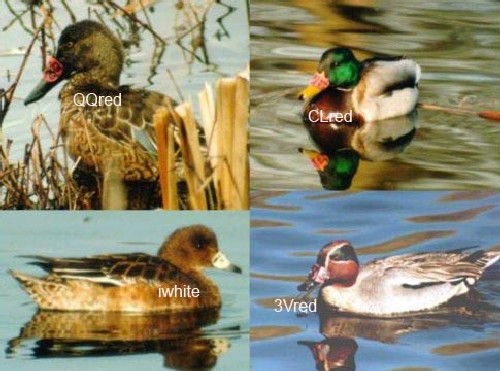
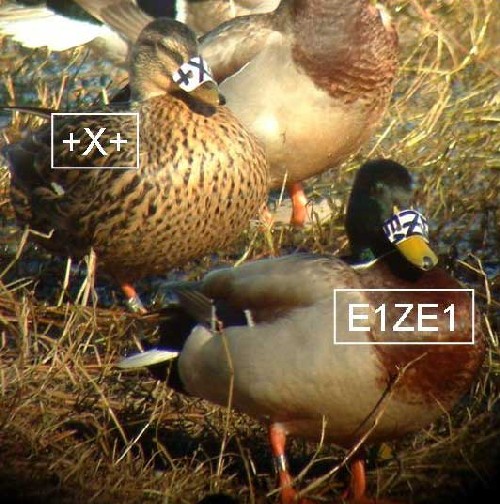
We control marked ducks with the help of telescopes,
since with binoculars we only can read codes
of birds at very close distances. Nasal saddling is the most
efficient safe marking process on ducks, but there is a limitation of the
distance you have to reach the marked duck to read alpha-numerical codes (+-350 m
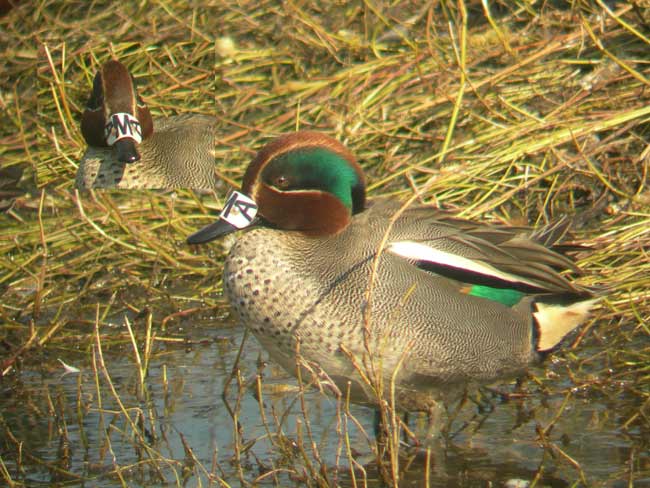
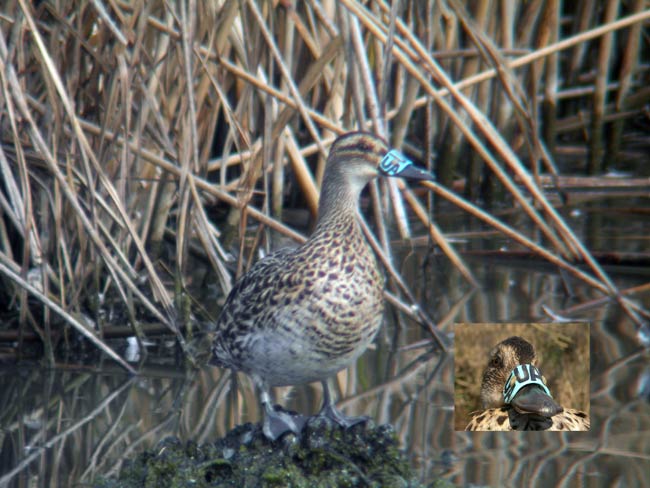
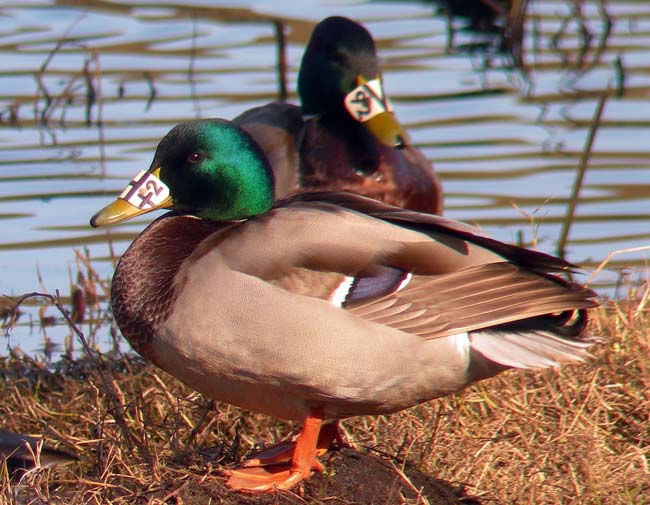
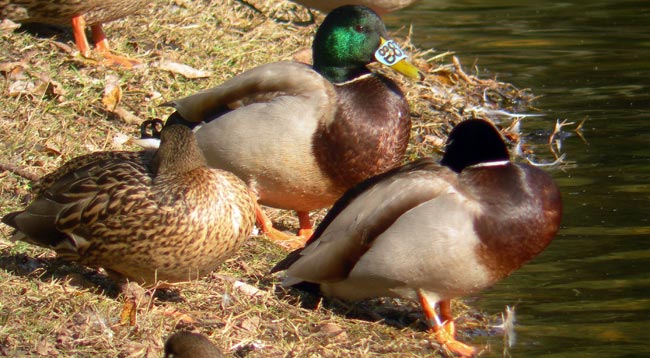
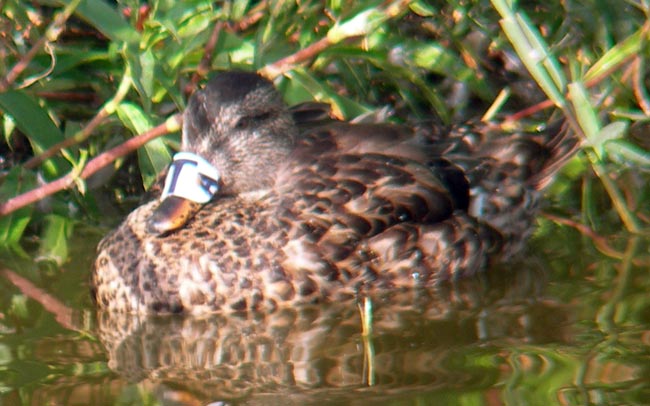
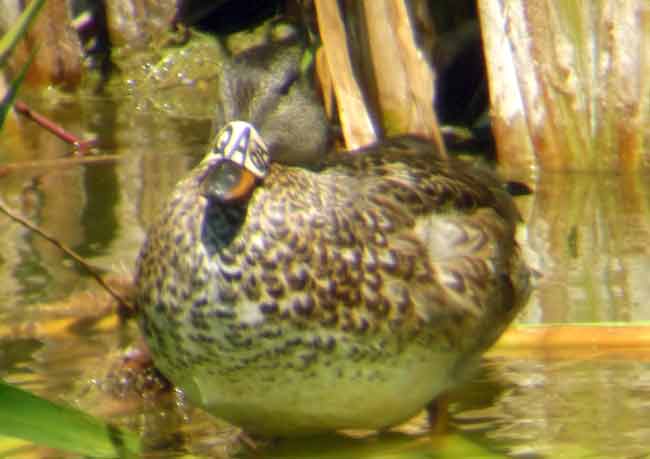
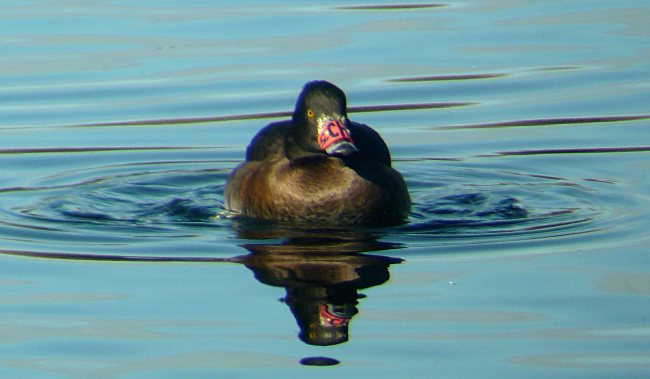
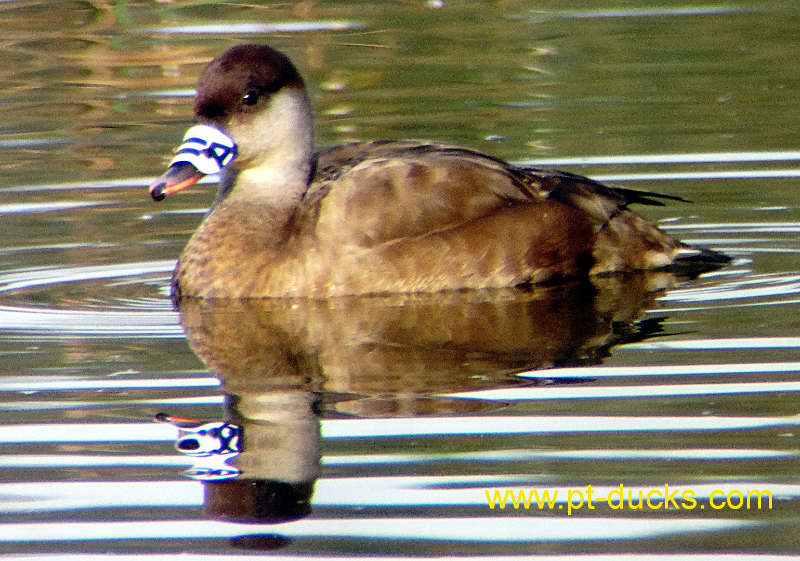
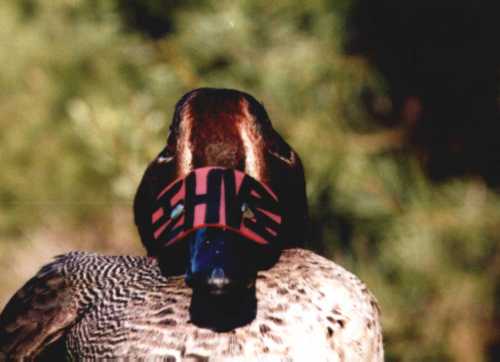
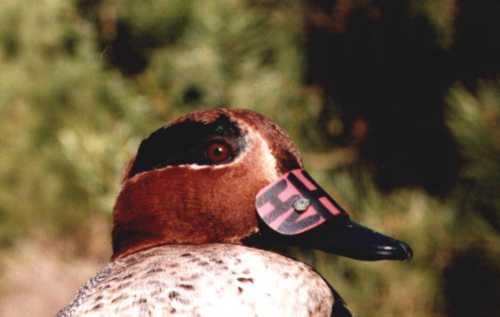
with a 30x-90x telescope, for mallard size codes). As you can see in the photos, the code
can be
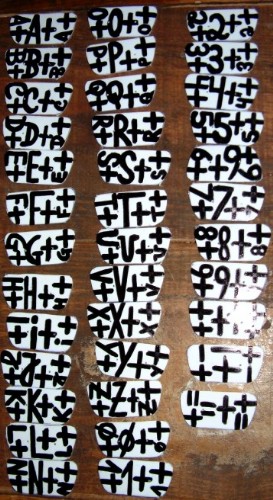
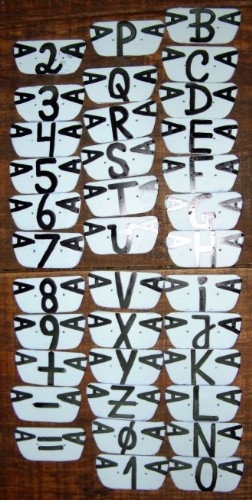
repeated in both sides and in the front, allowing the reading of codes in
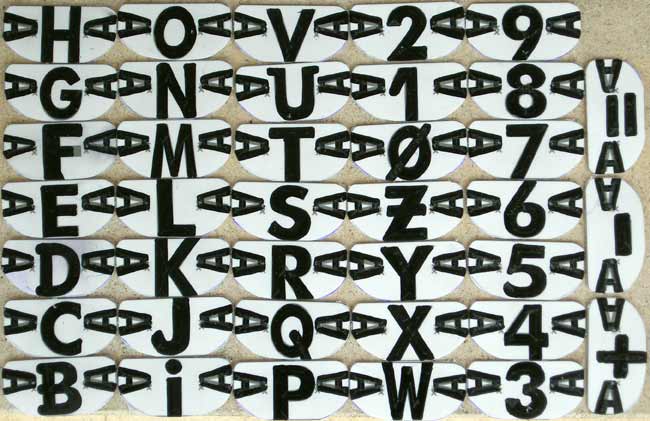
all of those sides. We use series with 1 or 2 letters and/or numbers number
(and also +, - and =, see photos). On Mallard, Shoveler, Pintail
and Wigeon with
white colour, we started to use different combinations of codes: – lateral
codes are equal but different from the front code. Like this we increase the
total number of combinations for the same colour (see photos).
During the winter 2005/6 we started to use the
same with Teal on white, introducing the LASER printed codes, although we
still apply a layer of ink with a pen to increase readability. The more
recent
printing process also allowed us to use more symbols (see
photos - Mallard codes after
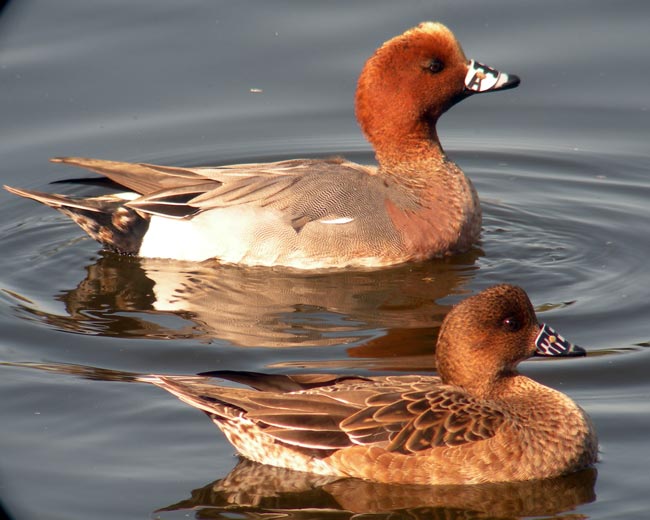
the crecca and querquedula photos. Wigeon LASER codes and
photos (only male has LASER print) are after the Mallard. On Gadwall we used
codes similar to Wigeon or codes with 2 digits - in this case, repeated in
all sides. After 2009 shovelers were marked with one digit repeated laterally
but different in front, like in wigeons), and
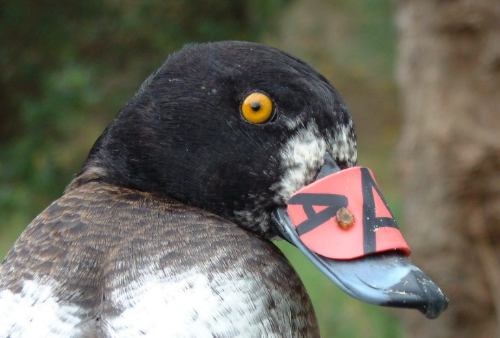
tufted ducks start to receive LASER printed saddles during 2011, using the
H series.
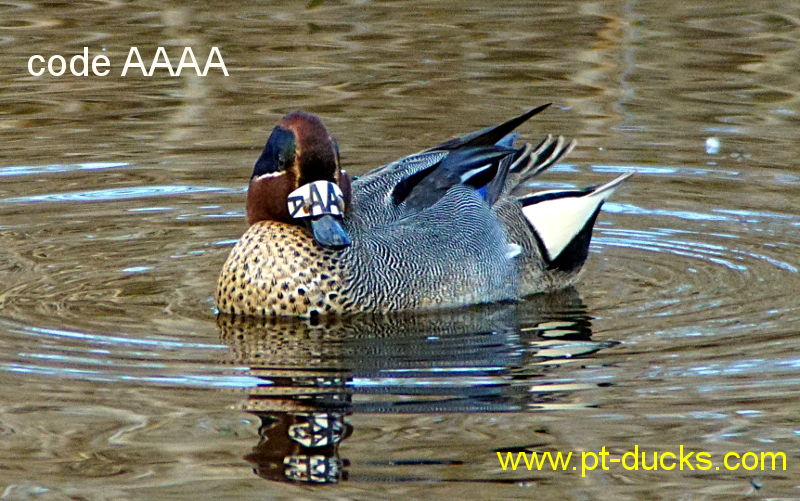
As we used all code combinations on teal, with 2 and 3 digits, at the end of
2016 we started to use 4 digit saddles, with one digit equal on both lateral
side and 2 digits in the middle/front (see new
teal codes).
Colours we
use are:
Anas platyrhynchos – white and light blue (old saddles also on red
and yellow);
Anas crecca – white and light blue
(old saddles also on red and yellow (only one
letter), see Note below);
Anas carolinensis – white
(old saddles also on red);
Anas querquedula – white and light blue
(old saddles also on red);
Anas penelope – white
(old saddles also on red and light blue);
Anas strepera – white
(old saddles also on red and light blue);
Anas acuta – white
(old saddles also on red and light blue);
Anas clypeata – white
(old saddles also on red and light blue);
Aythya affinis – red;
Aythya collaris – red;
Aythya ferina - red;
Aythya fuligula – red;
Aythya marila – red;
Netta rufina – white;
Marmaronetta angustirostris - white and light blue;
Cygnus olor – white.
Note: - some colours can be difficult to split on not so
good light conditions or if saddles are a bit diry. On most situations there will be no problem since
there aren't similar colours on the same species. On teal there can be some
mistakes between yellow/white and light green/light blue. The yellow and
light green are Teals marked in France (see bellow)
and can be easily split from the white and light blue
(marked in Iberia), through the
codes used: - in France the codes have 2 digits equal laterally and only 1 digit in front
(older saddles can have 1 digit equal laterally but without code in front). In Iberia, teal saddles can have 1 or 2 digits equal in
all sides, except in white where are used also 1 digit equal laterally and 1
different digit in front (in case of French teals, 1 digit saddles don't
have front code) or, in white and light blue, with one digit laterally
(equal in both sides), and 2 digits in the front/middle - see
new teal codes.
I will be very grateful if you send me information about resightings of our
ducks. Please indicate code and colour of the saddle, sex of the bird, the
date and hour, place (with coordinates in Lat Long) and country of
resighting. For those with Smart Phone I recommend the use of the birdring
apps
http://birdring.nl/en/ since it helps finding the right coordinates of
the resighting place on 2 standard formats and receiving all other
information needed - it helps you also managing your resight information.
Other project using nasal saddles on ducks in Europe can be found at:
http://www.oncfs.gouv.fr/Teal-research-program-ru141
Other projects of marked ducks and other bird species on Europe can be found
at:
http://www.cr-birding.org
And their photos at:
http://www.crb-photoguide.com/
Scientific studies about nasal saddles on ducks:
2001. Rodrigues, D.J.C., Fabião, A.M.D. & Figueiredo, M.E.M.A. The use of nasal markers for monitoring Mallard populations. Pages 316-318 in R. Field, R.J. Waren, H. Okarma, and P.R. Sievert (eds.). Wildlife, land, and people: priorities for the 21st century. Proceedings of the Second International Wildlife Management Congress. The Wildlife Society, Bethesda, Maryland, USA. (copies can be obtained through me)
2007. Guillemain, M., Poisbleau, M., Denonfoux, L., Lepley, M., Moreau, C., Massez, G., Leray, G., Caizergues, A., Arzel, C., Rodrigues, D. & Fritz, H. Multiple tests of the effect of nasal saddles on dabbling ducks: combining field and aviary approaches. Bird Study 54: 35-45 (copies can be asked to matthieu.guillemain@oncfs.gouv.fr).
2008. Guillemain, M., Lepley, M., Massez, G., Caizergues, A., Rodrigues, D. & Figueiredo, M. Addendum: Teal (Anas crecca) nasal saddle loss in the Camargue, France. Bird Study 55: 135-138 (copies can be asked to matthieu.guillemain@oncfs.gouv.fr).
2026. Guillemain, M., M. Gelin, B. Plaquin, E. Gregorczyk, J. Champagnon, and L. Bacon. Nasal saddles reduce survival rate in Eurasian teal. Journal of Wildlife Management e70181. https://doi.org/10.1002/jwmg.70181
Scientific paper showing nasal saddles efficiency on ducks:
Last updated in 14-02-2026
Contact:
David Rodrigues (PhD)
Coordinator for duck nasal marking in Europe, from
DSG (WI/IUCN)
Departamento Florestal
Escola Superior Agrária de Coimbra
3040-316 COIMBRA
PORTUGAL
drodrigues@esac.pt (If you have problems with this e-mail account
please send e-mail to djrodrigues@gmail.com
)
Phone: (351) 239 802 285
Fax: (351) 239 802 289; 239 802 979
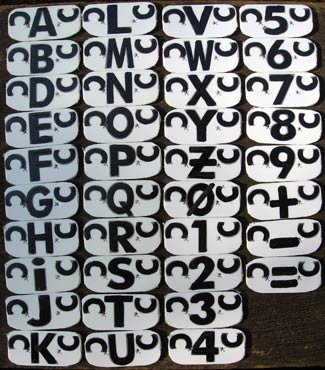
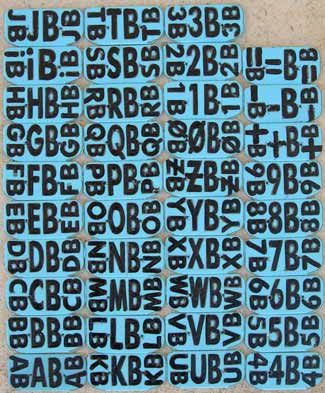
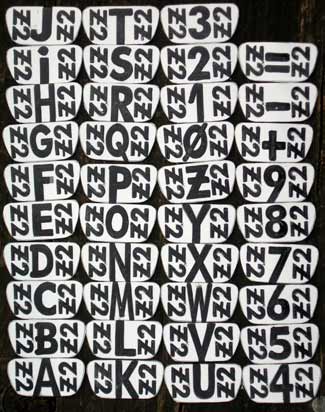
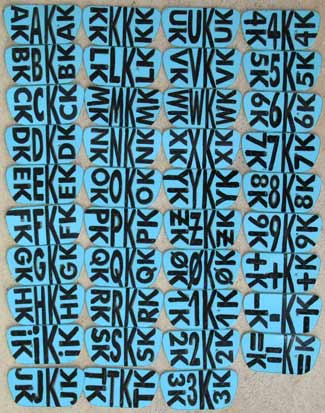
Bellow are the more recent code version used in teal nasal saddles, on white and light blue.
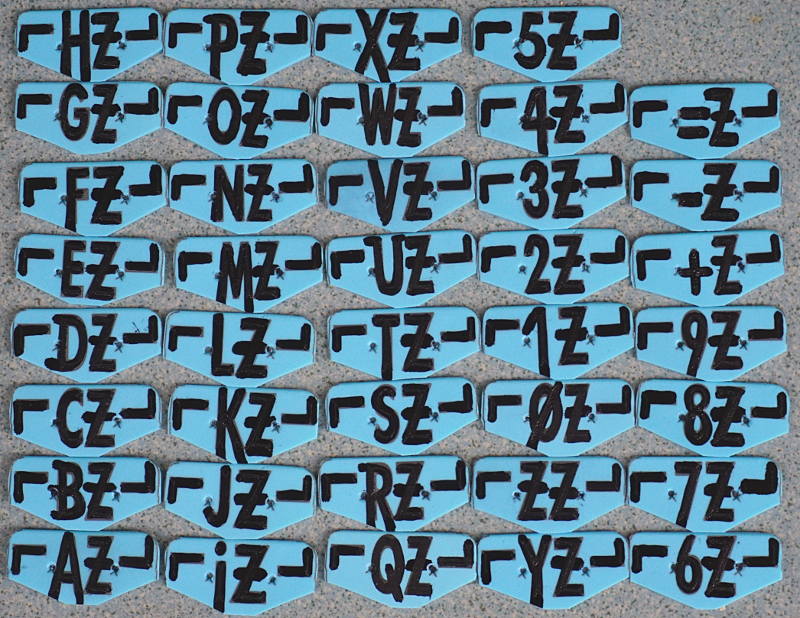
Bellow are hand written codes of nasal saddles used before the LASER print ones:
The following video shows how nasal saddles are applied: